
Why the energy transition is a myth
Europe has doubled its share of renewable energy over the past 20 years. Meanwhile, however, global consumption of fossil energy keeps rising, notes guest author Néckel Polfer.
The goal of the 2016 Paris Climate Agreement (signed by 195 countries) is to ideally limit global warming to a maximum increase of 1.5 degrees Celsius. According to climate models, greenhouse gas emissions — CO₂ above all — would need to be cut by 50 percent by 2030, and reach net zero by 2050.
Europe's energy transition away from fossil fuels toward renewable energy is described by many as pioneering in reaching this goal. Indeed, in Europe the share of renewables more than doubled between 2005 and 2023, from 10.2 to 24.1 percent of total energy consumption (1).
However, these statistics say little about the extent to which the world as a whole is turning its back on fossil fuels. Global consumption of fossil energy has increased by 40 percent over the past 20 years (2).
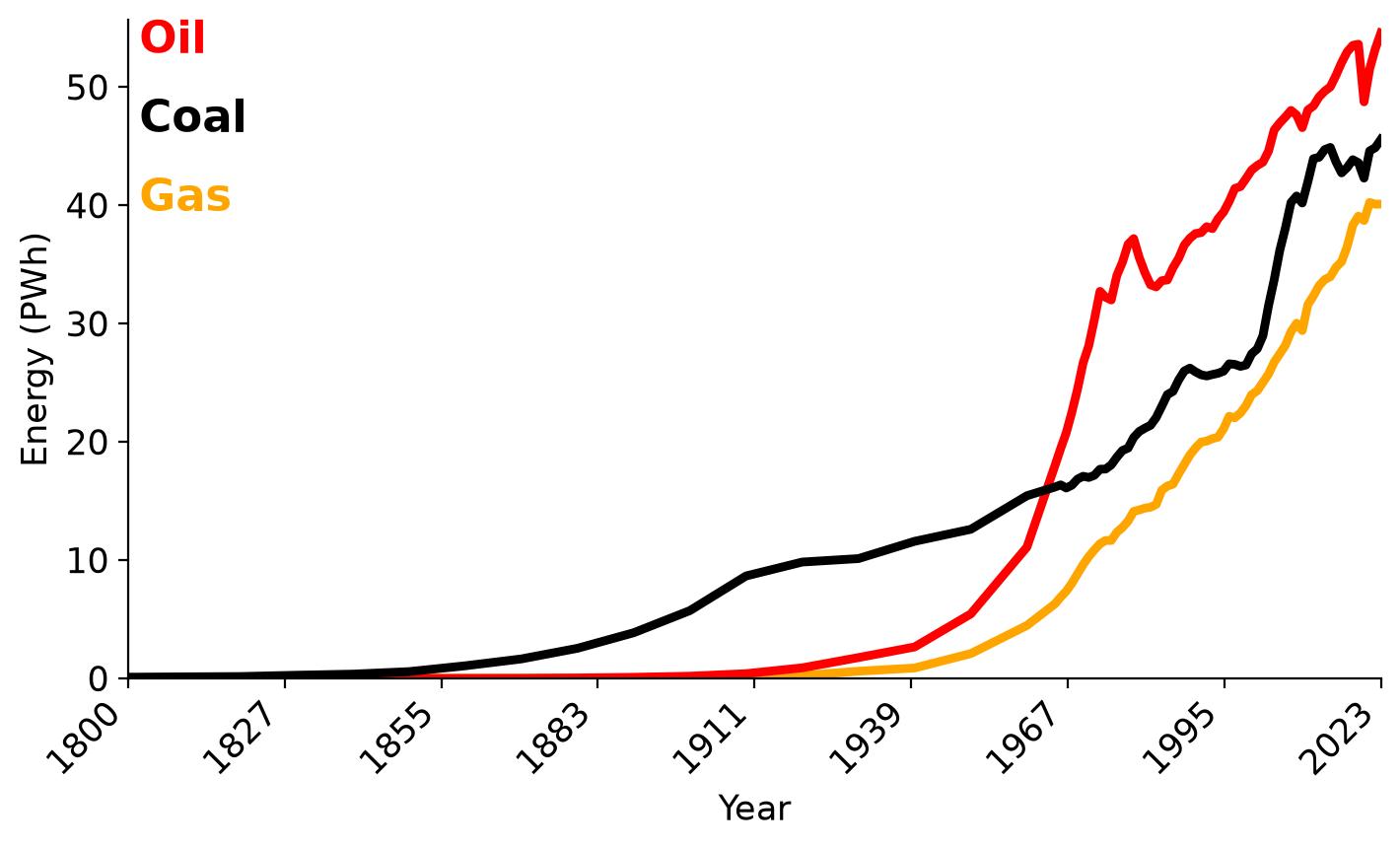
Given the seemingly unstoppable rise, particularly of oil and gas, a leveling-off is not to be expected any time soon, let alone a reduction, or even a transition to a CO₂-neutral economy. The share of fossil energy in total energy consumption also remains constant at over 80 percent.
Since climate change is a global phenomenon, it appears that there has been hardly any progress in decarbonizing the world economy, despite all the climate conferences (Kyoto, Copenhagen, Paris, etc.).
Historical myths of energy transitions
Industrial history teaches us that wood, a renewable raw material, was first replaced by coal as the energy source for steam power. Later came the switch to oil, because of the internal combustion engine.
It therefore seems logical that the transition to renewables represents a further stage in human history. But as the French energy scholar Jean-Baptiste Fressoz very clearly describes in his book "Sans transition – Une nouvelle histoire de l'énergie" (3), what actually took place were not really transitions from one energy source to another; rather, the old energy sources persisted, while new energy resources were added on top.
Even though the relative importance of the various energy sources has changed over the years, the absolute consumption of each resource has steadily trended upward, or at least remained high.
Nor is it true that the various raw materials are locked in a merciless competition with one another. Often they enable one another — for example, wood was indispensable for building underground coal mines or as railway sleepers. That is why wood consumption remained high, even as coal was burned in place of wood.
Today, the expansion of renewable energy is made possible by fossil fuels — for instance, coal power in the very energy-intensive manufacturing of solar panels in China, or diesel to run heavy machinery when mining mineral raw materials for batteries.
The expansion of renewable energy requires an enormous input of energy and resources, made possible by fossil fuels.
Reducing the CO₂ footprint
It is not only driving or flying that leads to CO₂ emissions. Because fossil energy plays such an important supporting role throughout the economy, the CO₂ footprint of many consumer products is surprisingly high. Producing one kilogram of tomatoes in heated greenhouses, for example, consumes half a liter of diesel; producing one kilogram of sea bass consumes even more than two liters of diesel (4). We are, quite literally, eating oil.
The simplest way to reduce one's CO₂ footprint would be to reduce one's consumption. In a capitalist consumer society, that is of course wishful thinking.
Instead, European policy aims to relocate energy-intensive industries abroad by means of high energy prices, in order to improve its own statistics. But such local action cannot solve a global problem like the human-made greenhouse effect. On the contrary, given the long transport distances and the less efficient energy use in developing countries, emissions are actually increased further. Europe is de-industrializing, yet continues to consume without restraint.
Another way to reduce CO₂ emissions would be to massively expand nuclear power, so that CO₂-free nuclear energy actually replaces fossil energy. Politically, however, this solution is not feasible in many European countries. As the past 15 years in Germany have shown, people are more willing to tolerate especially climate-damaging coal power than nuclear power.
Changing the Earth's surface and atmosphere as a solution?
Given the growing energy needs of developing countries and of energy-hungry artificial intelligence, Europe's energy transition resembles a drop in the ocean. If temperatures really rise steeply this century, as climate models predict, what countermeasures would remain?
In that case, geoengineering/climate engineering could no longer be ruled out (5). This involves a deliberate alteration of the Earth's surface and atmosphere in order to steer the climate.
For example, the Earth's surface could be cooled with the help of reflective particles in the upper atmosphere; these act like a shield, so that less sunlight reaches the Earth's surface. In fact, volcanic eruptions are a natural occurrence of exactly this process.
Incidentally, the doubling of CO₂ levels in the atmosphere is a type of geoengineering. Ultimately, a certain amount of climate regulation is well worth pursuing: neither an extreme greenhouse effect nor a new ice age would be in humanity's interest.
* The author holds a Ph.D. in chemistry and is climate alderman ("Klimaschöffe") of the municipality of Weiswampach.
Sources:
(1) ec.europa.eu/eurostat/statistics
(2) https://ourworldindata.org/fossil-fuels
(3) Fressoz, Jean-Baptiste, 2024, "Sans transition – Une nouvelle histoire de l'énergie," ISBN 9782021538564.
(4) Smil, Vaclav, 2022, "How the World Really Works," ISBN 9780241989678.
(5) Morton, Oliver, 2016, "The Planet Remade," ISBN 9780691148250.